If you have ever asked whether your money should go in an RRSP or a TFSA, you are in good company. It is one of the most common questions I hear. But it is usually not the first question to ask.
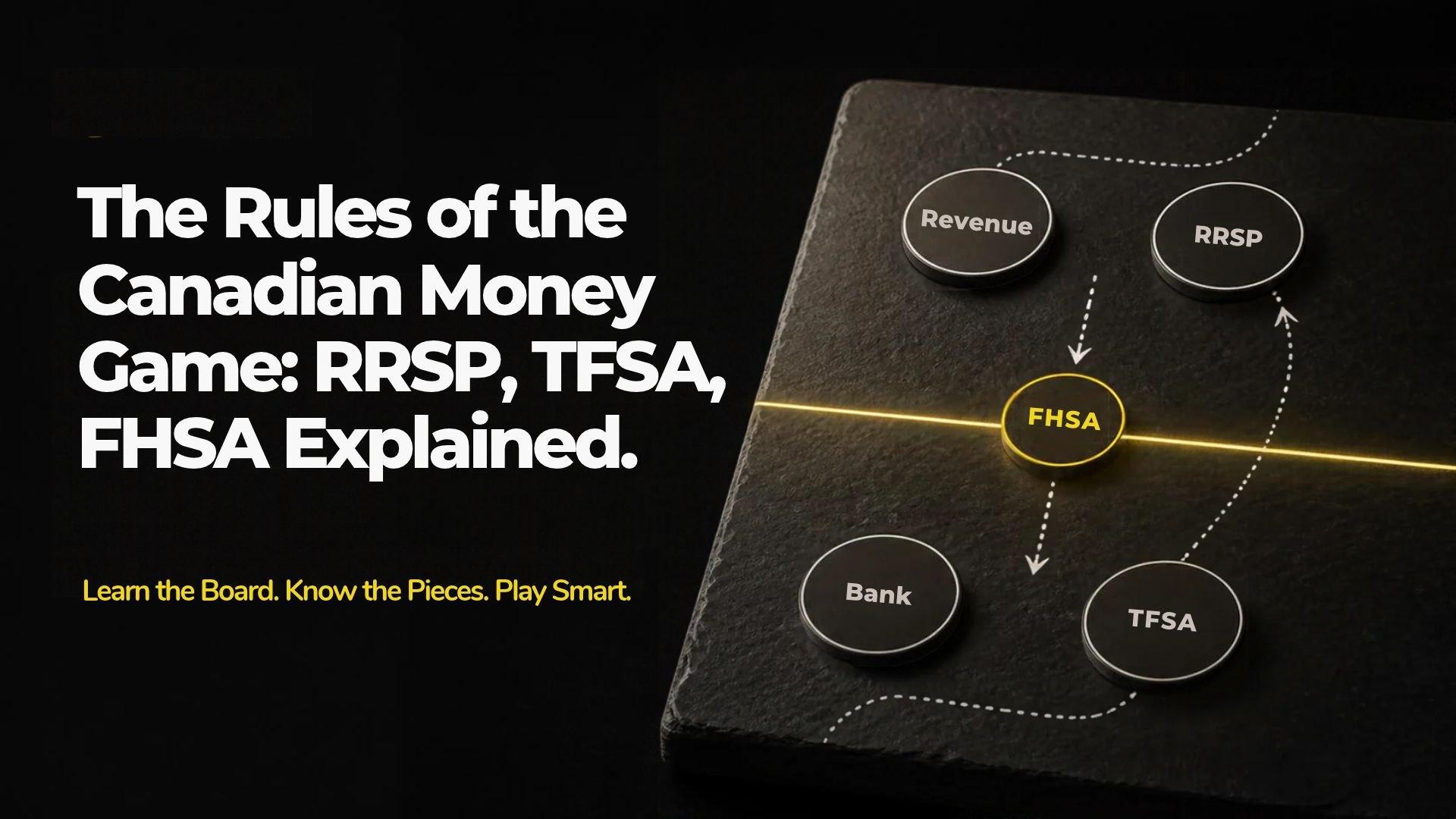
Before you compare accounts, it helps to see how the board is laid out. In this article I will walk through the Capital Strategy Circuit, the simple picture I use to explain how the main Canadian accounts work. It is four boxes, one line and a few arrows.
Why RRSP versus TFSA is the wrong starting point
RRSP or TFSA? Should I leave money in my corporation? Is the FHSA worth it? Those are all good questions. The trouble is that you cannot answer them well until you understand how the pieces fit together.
Most Canadians were never taught the rules. So we end up arguing about which account is "better" when the real issue is what each account is for. A better first question is this: which side of the tax line is my money on?
Two zones and a tax filter
At any moment, your money is in one of two zones.
Pre-tax money: money that has yet to be taxed to you personally.
After-tax money: money that has already been taxed to you personally.
The line between them is what I call the tax filter. All money, at all times, is on one side of it. When money crosses the line, something happens: you pay tax, or you get a deduction. When it stays on the same side, it can usually move around without that kind of tax event.
Four places your money can live
The circuit has four boxes:
Your revenue source. This could be your business, a corporation or your employment. It sits on the pre-tax side.
Pensions and RRSPs. Also pre-tax.
Your bank account. Money that is yours to spend, already taxed. After-tax side.
Your TFSA. Also after-tax.
The pre-tax side: pensions and RRSPs
If you have a business, a corporation or an employer, money can be set aside into a pension or an RRSP without crossing the tax line. It is either money that has not been taxed yet, or money where you are deferring personal tax. That is what an RRSP is: a way to defer tax to a later date.
I sometimes describe it as an interest-free loan from the CRA. It is tax you would otherwise have paid this year. The government lets you defer it, invest it and let it grow tax-deferred. When you take money out personally, it crosses the line and is taxed in that year. What is left is yours to spend.
You can also move after-tax money from your bank account into your RRSP. That crosses the line in the helpful direction, and you receive a deduction. You recapture some of the tax that was paid on its way to you.
The after-tax side: your bank account and your TFSA
If you keep after-tax money on the after-tax side, the TFSA is usually the natural home. It sits on the same side of the tax line. As the name says, it is a Tax-Free Savings Account, so growth is tax-free within the limits. It is not deferral. It is tax-free.
The FHSA: a blend of the two
The First Home Savings Account blends features of the TFSA and the RRSP. Within the limits, you get a deduction when you put money in. If you use it for a qualifying first home purchase, you can take it out tax-free. Unlike the Home Buyers' Plan, there is nothing to pay back.
If you do not buy a home, you can roll it into your RRSP. It will eventually be taxed there, but you keep the option. In the circuit, it is the one account that gets the deduction going in and skips the tax coming out.
Non-registered accounts
Non-registered accounts are the ones without the acronyms and without contribution limits. Most of the wealth I see in Canada sits in them. Your everyday chequing or savings account is technically non-registered, and if it earns interest you will get a tax slip.
They can be held personally or inside a corporation, and the tax is different in each case:
Personally held: you pay tax on the investment income each year. They sit in the same place as your bank account in the circuit.
Corporately held: the corporation pays tax on the investment income, and if you pay yourself from it, you cross the tax line personally. They take the place of your revenue box.
It also helps to think of every account as a container. A TFSA can hold cash, or it can hold stocks, mutual funds or ETFs. The account sets the tax rules. What you put inside is a separate decision.
Every account has a limit
The limits matter, and they are worth checking each year. As discussed in the video:
FHSA: room starts to build when you open the account, at $8,000 per year up to $40,000.
TFSA: room has built up since 2009 for those who were eligible, reaching $109,000 in 2026.
RRSP: generally 18 percent of earned income, up to a maximum, and it carries forward.
For business owners, one detail stands out. RRSP room is based on earned income. Dividends from your own incorporated business do not add to it. That is why many professionals pay themselves a mix of salary and dividends, so room keeps building while there is plenty of time for tax-deferred growth.
The circuit in one sentence
Two zones, one filter and three kinds of moves: money that moves with no tax, money that crosses down and gets taxed, and money that crosses up and earns a deduction. Pensions and RRSPs live above the line. Your bank account and TFSA live below it. Every account has a job, and every account has a limit.
What comes next
Knowing the rules is the first step. The harder question is in what order to use these accounts, and how to bring money back out as efficiently as possible. That depends on your income, your goals and your timeline, which is why general information is only a starting point.
If you would like to see your own circuit mapped out, you are welcome to book a conversation at onvisor.ca. No pressure, just a practical chat.
Check out the full lesson on Youtube here.
This article is general information only and is not personal tax, legal or investment advice. Limits and rules change, so please confirm current figures with the CRA or a qualified professional.