Here's something I see more often than I should. Someone maxes out their RRSP every year, then puts a new roof on the house with a credit card because they don't have enough cash savings.
They're not bad savers. They're just saving in the wrong order.
That's the idea behind the retirement cascade, the third lesson in my framework series at Onvisor. In the Wealth Summit lesson, we worked out where you're going. In the Capital Strategy Circuit, we laid out the rules for each account: RRSP, TFSA, non-registered and corporate. Those are the pieces on the board. The cascade is how we actually play the game.
Saving isn't the goal. Saving is delayed gratification. The goal is your lifestyle, today and later. And whether you're on salary, self-employed or running a corporation, the framework is the same. The only thing that changes is which accounts go in which bucket.
Start with one question
Everything starts with a simple question: does more money come in than goes out?
Cash flow is the key to everything. There is no planning without positive cash flow. To put anything into this framework, you need surplus revenue on top of your expenses.
Think of that surplus as a tap you can open. It might be $1,000 a month, or $200 every two weeks. That tap feeds three buckets, in order.
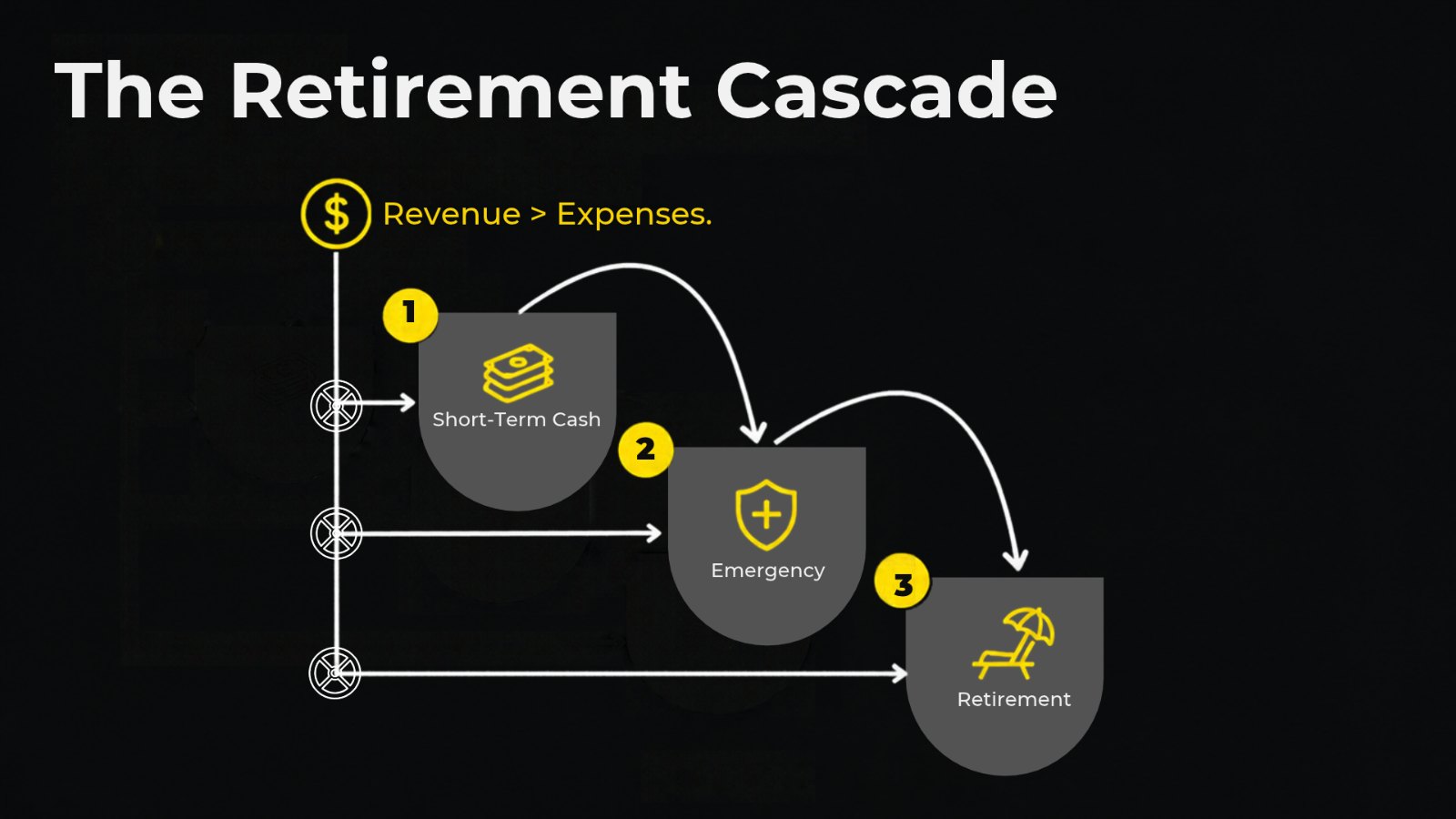
Bucket 1: your short-term cash
The first bucket sits in what I call the lifestyle zone. It's for short-term expenses, both the planned ones and the surprises: travel, winter tires, snow removal. If you're saving for a wedding or a down payment on a house in the next one to three years, I consider that short-term too.
For most people, this is a savings account over and above their chequing account. Chequing handles the weekly or monthly in and out. The savings account holds the things you plan for.
This bucket usually carries low to no risk. And it comes first for a reason. If you don't fund your short-term needs well enough, you'll probably have to dip into, or undo, the progress you made in the buckets below it.
Bucket 2: your emergency bucket
Once your short-term needs are covered, we open the second valve. This is where the accumulation quadrant begins: money you don't plan to need until further down the road.
The emergency bucket is for bigger setbacks, like a job loss or a disability, when your short-term savings aren't enough. You can invest this money for the longer term, but it should stay accessible. It shouldn't be locked in, and there shouldn't be tax consequences for dipping into it.
That's why the TFSA often works well here. You invest with after-tax dollars, redemptions aren't taxable and your gains aren't taxable, all within the limits of the account. If your TFSA is full, or you can't use one, a non-registered account can fill the role. Risk here is usually low to moderate, more of a balanced approach.
Bucket 3: retirement and beyond
Now, and only now, we open valve number three. This is the largest bucket, and it makes up the majority of the accumulation quadrant.
The RRSP often fits here, because it's money you don't intend to touch until retirement. If you're also saving for something beyond your own retirement, such as intergenerational wealth, non-registered accounts and trusts can fit in this bucket too.
This bucket has the longest time horizon, so it can carry more risk, moderate to high. You have more time to recover from market swings. And because buckets 1 and 2 are in place, you've done your best to make sure you never have to touch this one at a bad time.
How the cascade actually fills
Buckets get filled two ways. The first is the valves: your surplus, directed to whichever bucket is next. The second is overflow. When bucket 1 reaches its goal, the extra spills into bucket 2. When bucket 2 is where you want it, the extra spills into bucket 3. A raise, a bonus or an inheritance can do the same thing.
That's why I call it a cascade. Everything flows toward the largest bucket.
How much goes to each bucket, and in what order, is what's unique for everybody. That's the part worth working out with an advisor.
The mistake I see most
The number one mistake I see professionals and business owners make is skipping right to step 3. There's a bit of surplus, they're not sure what to do, and they go straight to the RRSP or long-term stocks because of the tax deduction.
I'm not saying investing for retirement right away is a bad idea. I'm saying don't do it without at least doing a little of step 1 and step 2.
When the paycheque stops
In retirement, the goal changes. Your revenue no longer needs to beat your expenses. It needs to match them.
The retirement bucket is meant to replace your income, a bit like a pension would. Because RRSP money is taxable, we plan the withdrawals to manage your taxable income, often with a set monthly amount that covers most of your lifestyle costs.
You'll still have surprises, like snow tires or a new roof. Now bucket 1 drains instead of fills, and the TFSA can top it up. If you need $30,000 or $40,000 one year and nothing the next, a TFSA withdrawal doesn't push up your taxable income the way the third bucket would.
Picture it this way: instead of taps filling the buckets, you now have pumps at the bottom pushing money back up. The cascade becomes a fountain.
Putting it together
Your revenue beats your expenses. That's your surplus. It fills short-term cash, then spills into your emergency bucket, then into your retirement bucket. Three buckets, three jobs, three levels of risk. Later, the retirement bucket pays you a planned income, and the emergency bucket tops up your cash when life gets lumpy.
This is general education, not personal advice. Your accounts, tax situation and goals are your own. If you'd like help working out what your own cascade could look like, visit onvisor.ca and let's talk it through.